
The poultry supply chain
SME's first step: strengthening the supply chain for poultry meat in Ethiopia, from fodder to consumer.
What SME does
SME will make its first step in supporting the development of supply chains for poultry meat. For this SME will cooperate with existing enterprises and associations. The Ethiopian Poultry Producer and Processors Association is for SME a well-known organization. The chairman is in the Ethiopian network of SME. See for more information http://ethiopoultryassociation.org.
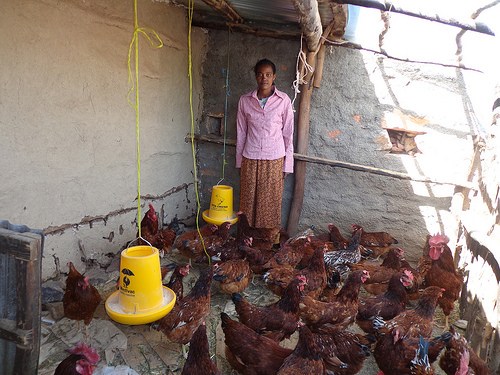
The heart of a supply chain must be the slaughterhouse and meat processing. From that central point is looked back to the input of fattened chickens with the farmers who do this part of the chain. The used fodder and its farmers are part of the quality care system.
Criteria for the fattening of chickens are among others:
- The quality of the fodder
- The quality of the hygienic and veterinarian system
- Attention for the welfare of the chickens, include use of medicine and antibiotics
The slaughterhouse and meat processing will have to fulfill severe criteria of hygienic conditions. The used system will be Hazard Analysis and Critical Control Points HACCP. This system guarantees good and safe food.
The processes of cooling and freezing are important. The use of sustainable energy will be promoted as much as possible.
The transport of chicken from the farmer to the slaughterhouse will also be part of the quality care system.
After the meat processing the product go to the customers. These can be retail (supermarkets), upper-class hotels, (big) national and international organizations like the African Union, embassies and aircraft companies.
The quality and quantity of the meat must be assured and the customer must be prepared to pay more money for the assured quality. This can and must be cheaper than the import of chicken meat from South Africa, Ukraine or Brazil, which happens now.
Why poultry?
The market for poultry meat is small, but growing. The production is for the national market, which fits to the starting points of SME. That means that the added economic value stays in Ethiopia which is beneficial for all the stakeholders in the supply chain. The investments for small and medium holder farmers are relatively small. If the quality of their farming is good, they can participate in a supply chain for poultry meat.
Next to that other criteria make the choice for poultry supply chains reasonable:
- The lifetime cycle for chicken is short, about 50 days. Results of investments are shown in a short time.
- The conversion from fodder to meat is much better for chicken than for beef, goat and sheep.
- The needed water for meat production is for chicken much less than for beef. Chicken needs 4 liter of water for 1 kg of meat, for beef 16 liters are needed.
- Chicken produces less greenhouse gases like methane than cattle.
- Poultry meat is white meat and this is considered to have less negative influence health than red beef. Medical research shows that Intestinal cancer can be promoted more by red than by white meat.
So from the point of view of sustainability and health chicken has advantages above red meat of beef, sheep, goat, pig and camel.

How SME works
SME will not create and invest in new supply chains. SME will work in such a way that what already is existing as components of supply will be strengthened. The several parts must form a more coherent chain. The quality of the chain must become such that stakeholders are eager to become a participant. The quality can be promoted by a new market-oriented brand.
The conditions for the quality must be monitored by a good integral quality care system. A well-equipped laboratory is needed for doing the necessary analysis and advices for improvement.
SME will find out what the present situation is by a kind of baseline research done by students or Ethiopian partners. This research will give insight in the existing situation and will lead to a plan of action and improvement. This plan exists of several components like:
- Needed investments. SME will help to find investors. The foundation itself will not be an investor.
- Needed expertise. SME will facilitate to find the good training and trainers.
- SME will support needed research for all parts of the supply chain, like a good market analysis.
- Quality care system. SME will support the realization of an up-to-date quality care system.
- SME will support the process that sustainability and animal well fare will be normal parts of a modern supply chain.
It means that SME will not do all the support itself, but will try to find the needed experts and the investors.
Cooperation
SME will realize its goals by cooperation with farmers, slaughterhouses, ngo’s and the Ethiopian government. In the existing network of SME many persons and organizations are present. The working visit of the board of SME in the summer of 2017 gave a good insight of the existing situation and the possibilities. Three enterprises are potential partners to start with in 2018.
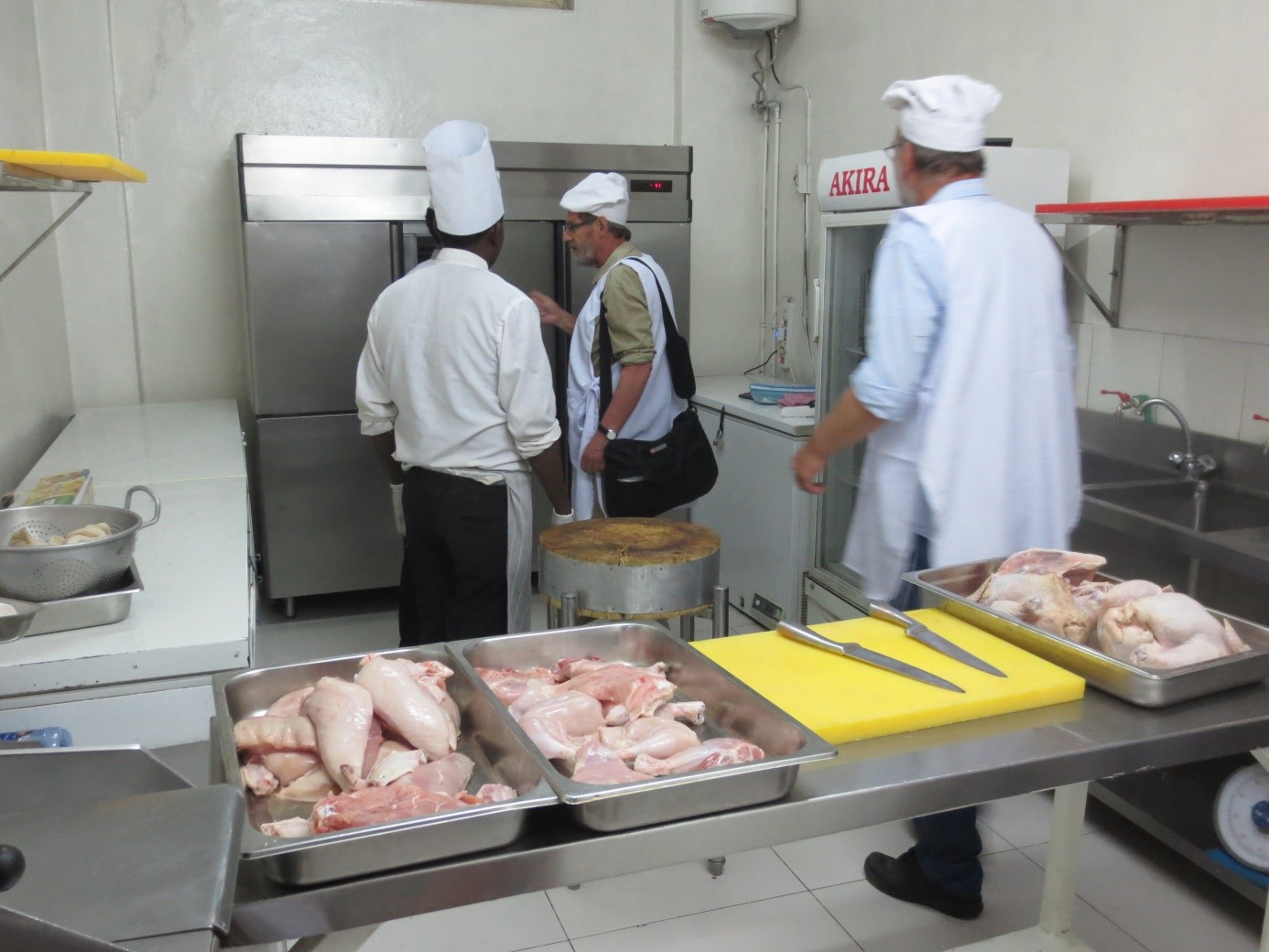
Fresh chicken meat in a first class hotel in Addis Ababa

Standards and targets: Chico Meat & SME
September 2018
The concepts are derived from the MoU.
Next to that the Sustainable Development Goals (SDG’s) of the UN offer a useful framework of reference. Also Ethiopia has signed these goals. See website: https://www.un.org/sustainabledevelopment/sustainable-development-goals/
A timetable has to be added to these standards and targets.
Goals
- To offer for the shorter and longer time perspectives and a framework of reference for the development of integral quality care system for the value chain of chicken meat.
- To create marketable chicken meat products by the system of HACCP++. This means: the regular risk evaluation system for food (HACCP) plus aspects as sustainability, animal welfare and corporate social welfare (the ++).
Definition and tasks of the value chain director
- Is supervisor of the complete supply chain. Has the overview and knowledge of the complete chain. Knows the situation of every stakeholder. Has authority, can and wants to convince.
- Signalizes bottlenecks, needs and wishes of the stakeholders
- Stimulates improvements on many areas, but certainly on the field of quality care
- Stimulates coherence and overall responsibility of stakeholders on the road to a ‘Community of Star Chicken’ and a chain convenant.
- Is point of contact for problems of several kinds. Helps to solve problems or appeal for external expertise
- Is in the chain the first one to take initiatives for further development of the market.
Food security
- Hazard Analysis and Critical Control Points (HACCP) as a starting point
- Meat is free from salmonella, campylobacter, listeria, etc.
- Meat is free from residues and antibiotics
- There is a good quality care system and the guarantee of it by inspections at all stakeholders.
Corporate Social Responsibility (CSR)
The standards are based on the 7th theme of the organization PUM (Netherlands senior experts)
- Good governance
- Human rights
- Labour conditions like safety, labour times and salary
- Environment, waste management, climate
- Fair trade
- Eye on customers and consumer interests
- Societal involvement
Sustainability
- Give content and meaning to the three P’s: people, planet and profit
- Use of sustainable energy from solar, wind, hydropower. The economic conditions should be incorporated.
- Circular economy: waste does not exist, be economical with waste
Animal welfare
- Standards of the ‘beter leven kip’ (better life chicken) are translated to the context and feasibility of the Ethiopian society.
- Minimum use of medicine by offering chickens an healthy environment
- Dry chicken houses to prevent for infections. Less illness, less medicine (less costs)
- Minimum of 4 hrs per day in darkness. This prevents stress and less chance on illness.
- Prevent appearances of chickens that grow too fast (weak legs, etc.)
Memorandum of Understanding
SME formalised its cooperation with its Ethiopian partner in a signed Memorandum of Understanding (MoU). The MoU lays down the shared goals and the standards and targets for the poultry value chain.